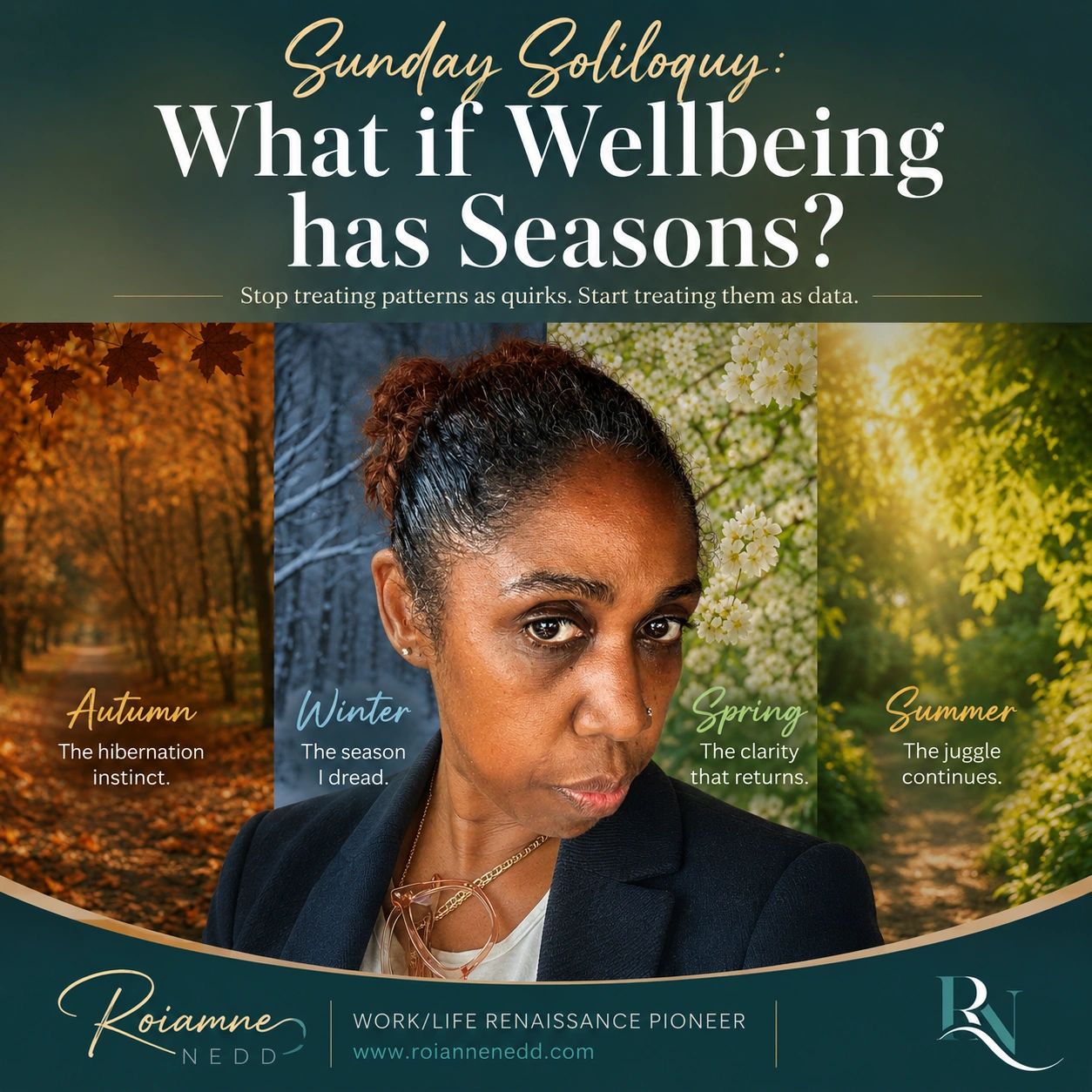
It's the last Sunday of August. The light is already changing. And for the first time, I'm going to admit something out loud that I've felt for years but never quite named: I dread winter.
Not in a vague, "ugh, it's cold" way. In a real, physical, this-changes-how-I-show-up way. I think I'm someone who lives with seasonal affective disorder, even if I've never sought a diagnosis. And rather than file that away as a personal quirk, I've decided to use it. Because if the seasons move through me this predictably, they're moving through my colleagues, my clients, my teams too — and almost nobody is building a wellbeing strategy around that truth.
That's the next chapter of my Work/Life Renaissance work: what does it actually mean, professionally, to be a seasonal person?
Let me walk you through my year, because I think you'll recognise parts of it.
Autumn is my preparation season. As the temperature drops, so does my appetite for networking. I want to be home more. And instinctively, I start behaving like something getting ready to hibernate — reviewing what needs a refresh, talking to stakeholders, gathering evidence. I'm not slowing down. I'm stockpiling, so that when winter comes, I can retreat into focus work: rebuilding, refining, going inward.
Winter, if I'm honest, I detest. Apart from Christmas and my birthday, it's a season I endure rather than enjoy. The short days and early nightfall make the commute brutal and the boundary between home and work almost impossible to hold. I want to disappear into the work I prepared for in autumn and resurface when the light comes back.
Spring is when hope returns. I see it in the ground before I feel it in myself — buds first, then me. I'm creative all year round, ideas tumble out of me constantly, but spring is different. Spring is when I stop generating and start solving: stepping back, assessing the real problem, finding the right answer rather than the fastest one.
Summer is the juggle. I love it — the networking, the people, the catching-up energy of it all — but it collides head-on with six to eight weeks of school holidays and a home life that suddenly demands far more of me. Summer is expansive and exhausting in equal measure.
I'm not sharing this as a personality quiz. I'm sharing it because I don't think I'm unusual. I think most of us have a seasonal rhythm we've never been given permission to name — and workplaces have not caught up.
Here's where it gets uncomfortable. Hybrid work policies that force everyone back into the office on a fixed schedule are taking a short-term view of a long-term problem. If we actually cared about sustainable performance, we'd focus on outcomes, and on intentional time together — curated, supported, built into cultures that are genuinely inclusive and welcoming. That's a different soliloquy for another Sunday. But it's connected.
Because wellbeing strategy has to underpin all of it, and right now, most of it doesn't.
As we head into the darker months, what's actually available for someone quietly struggling with seasonal affective disorder? Pointing them to the Employee Assistance Programme is not a strategy. It's a fallback. Real wellbeing support has to be intentional and proactive, not a phone number people are supposed to remember to call on their worst day.
This is why I build mentorship and colleague buddying programmes designed around regular, structured touchpoints — so nobody has to reach out in crisis to get support. They already know that in three weeks, someone checks in. It's horizon scanning. It's pattern recognition. It's a communication strategy that names what someone might be experiencing before they've named it themselves. And it's just-in-time resourcing, for the individual, for their team, and for the leader trying to support them.
My approach comes down to three things, working together:
- Proactive education and support— so people understand what they might be feeling before it becomes a crisis.
- Just-in-time resourcing— so the right information is there the moment it's needed, not buried in a policy document.
- Speedy resolution— so nobody in crisis is left waiting for help to arrive.
I used to think my relationship with the seasons was just something I managed quietly, on my own. Now I think it's data. And organisations that learn to read it — in themselves, in their people — will build wellbeing strategies that don't just react to winter. They'll be ready for it.
If you'd like to talk about what this could look like inside your organisation, let me know. And if you'd like my template wellbeing strategy one-pager, just ask — I'll send you the link.
I'm Roianne Nedd, a leadership advisor, organisational culture consultant, keynote speaker, author and fractional Chief People Officer. I help leaders and organisations build healthier cultures, navigate change with confidence and create workplaces where people and performance can thrive together. If you'd like to follow my work, I'd love to stay connected: Join my community here.